Types
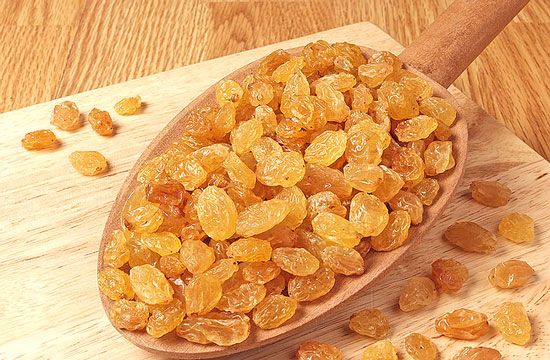
Golden raisin
After collecting the grapes from vineyards, grape clusters are conveniently threaded together in 2-3 meter lengths and in order to reduce drying time, they are immersed in a solution of potassium carbonate, oil and water. The threaded bunches of grapes are then hung from the ceiling of shaded cellars away from the sunlight. They are then fully covered and passively smoked with SO2 for about 7-8 hours. The covers are then removed and the grapes are left to gradually dry for about 2-3 weeks.
Sultana raisin
After the immersing stage (similar to the Golden Raisins) is spread on a clean surface e.g. concrete or special paper under direct sunlight and it gets dried in about 5-6 days. It is then transferred to the factory to undergo the process of cleaning and packaging. This type of raisin is brown in color; it is very sweet and flavorsome.
Malayer raisin
This type of raisin, similar to Sultanas, undergoes various stages of preparation. The only difference between Malayeri raisin and Sultana raisin is that Malayeri is lighter in color (hence the name Light Sultana). It was originally produced in Malayer, and it takes its name from there. It should be noted that although Malayeri type is lighter in color, it contains less sugar and is not as sweet as Sultana.
sulphur level
Our raisins comply with SO₂ limits: up to 2000 mg/kg for the EU and Russia, ensuring both safety and premium quality.
All products meet international food safety standards for dried fruits.
Moisture level
Our raisins maintain optimal moisture levels below 18%, as required by both EU and Russian regulations.
This ensures long shelf life, safe transport, and resistance to mold or fermentation.
Each batch is tested to guarantee consistent quality and compliance with export standards.
Size and Grade
1. Size by Number (e.g., No.9, No.10)
- The number refers to the average berry diameter in millimeters (mm).
| Size | Size Code (Number) | Berry Diameter (mm) | Short Description |
|---|---|---|---|
| Very Small | — | < 6.0 | Tiny berries; industrial use |
| Small | — | 6.0 – 7.0 | Small; suitable for bakery |
| Medium | No.7 | 7.0 – 7.5 | Medium; general consumption |
| Large | No.8 | 7.5 – 8.0 | Large; common for export |
| Large | No.9 | 8.0 – 8.5 | Larger; popular in retail |
| Jumbo | No.10 | 8.5 – 9.0 | Very large; premium quality |
| Jumbo | No.11 | 9.0 – 9.5 | Extra large; luxury grade |
- The higher the number, the larger the raisins, and usually the higher the price.
- For example, No.9 means the raisins have an average diameter of 8.0 to 8.5 mm.
In some markets (e.g., Europe), raisin size may also be indicated by the number of berries per 100 grams (e.g., 220–240 berries/100g).
2. Grade by Letters (A, AA, AAA)
- The grade indicates the overall quality of the raisins, not their size.
- More “A” letters indicate higher quality:
| Grade | Description |
|---|---|
| A | Standard quality – slight color variation, up to 3–5% defects |
| AA | Good quality – more uniform color, max 2% defects |
| AAA | Premium (superior) quality – excellent color uniformity, very clean, less than 1% defects |
- AAA is often used for direct human consumption and retail packaging.
- A or AA grades are usually used for industrial purposes or bulk processing.
Example: Golden No.10 AAA = Golden raisins, large size (8.5–9 mm), premium quality.
Health Benefits
Golden & Sultana Raisins – Iran
- Rich in natural antioxidants (polyphenols)
- Good source of dietary fiber – supports digestion
- Contains iron – helps prevent anemia
- Provides potassium – supports heart & blood pressure
- Natural energy booster (fructose + glucose)
- Contains boron – supports bone health
Nutritional Profile (per 100 g)
| Nutrient | Approx. Value |
|---|---|
| Energy | 299 kcal |
| Carbohydrates | 79 g |
| Sugars | 59 g |
| Fiber | 3.7 g |
| Protein | 3.1 g |
| Fat | 0.5 g |
| Potassium | 750 mg |
| Iron | 2.6 mg |
| Calcium | 50 mg |
| Vitamin B6 | 0.17 mg |